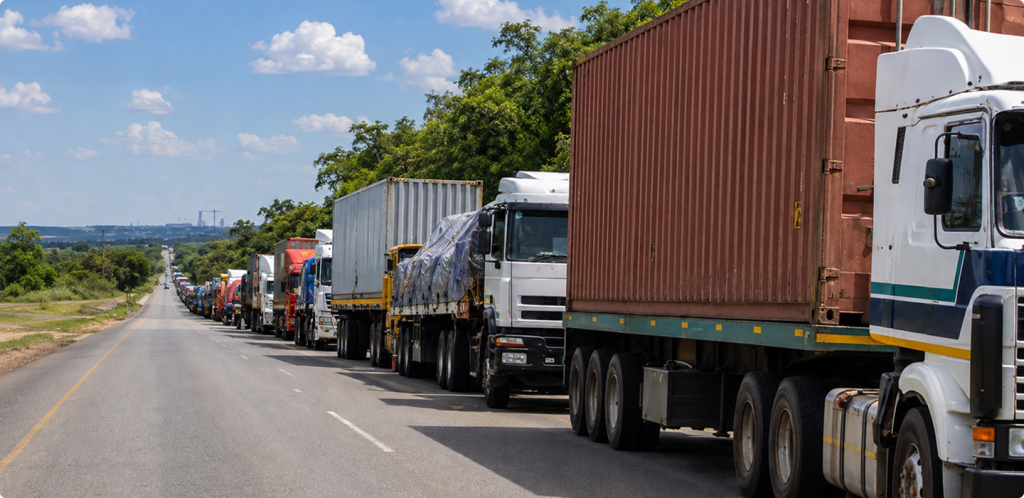
Ask a transporter why a load was late and you will usually hear about the border. Ask what was actually wrong and you will usually hear about a document.
Border delays are, more often than not, documentation delays wearing a different name. The customs process is fundamentally a document-checking process: the authority is comparing what you say you are moving against what is on the vehicle, and against what the rules require for that commodity. When those three things agree and the file is complete, the process is fast. When they do not, it stops — and it stops with your truck parked.
This is a practical guide to what a complete consignment file contains, who is responsible for producing each part of it, and the mistakes that most reliably send a load back into the queue.
The file has three parts
Most businesses think of “the paperwork” as one thing. It is easier to manage as three separate bundles, because each has a different owner and a different deadline.
Part one: the cargo documents
These describe the goods, and they are produced by the seller or shipper.
- Commercial invoice. The foundation document. Must show the full names and addresses of buyer and seller, a specific description of the goods, quantities, unit prices, the total value, the currency, the terms of sale and the country of origin.
- Packing list. How the consignment is physically made up — packages, marks and numbers, weights and dimensions. This is what the physical inspection is checked against.
- Transport document. The bill of lading, air waybill or road consignment note, depending on how the goods arrived and how they are moving.
- Certificate of origin, where the goods qualify for preferential treatment under a regional trade arrangement. If you are claiming a preference and the certificate is not correct, the preference is lost and the duty position changes.
- Permits, licences and certificates specific to the commodity. Agricultural goods, foodstuffs, chemicals, pharmaceuticals, used goods, electronics and controlled items each have their own requirements, and they differ on each side of the border. This is the category that most often surprises people.
- Insurance certificate, where required by the terms of sale.
Part two: the customs documents
These are produced by the clearing agent, from the cargo documents.
- The customs declaration on each side of the crossing — an export entry where the goods leave, an import entry where they land.
- Tariff classification for every line. Classification determines duty, and an incorrect code is not a small error; it changes the amount payable and can constitute a misdeclaration.
- Valuation basis — the declared value must be supported by the invoice and consistent with the terms of sale.
- Proof of duty and tax payment, or evidence of an approved deferment or bond arrangement.
- Transit documentation where goods are moving through a country rather than into it. Transit has its own controls, its own bonds and its own timelines, and it is not interchangeable with an ordinary import.
Part three: the vehicle and driver documents
These are the transporter’s responsibility, and they are the ones most often assumed rather than checked.
- Vehicle registration and licensing for the tractor and every trailer.
- Cross-border road transport permit for the route being run.
- Third-party insurance valid in the destination country.
- Carbon tax and road access payments where applicable.
- Driver’s licence with the correct code, plus a valid passport and any required visa.
- Driver’s supporting documents for the load — the file they present at the counter.
Who is responsible for what
The single most common structural failure in cross-border freight is an assumption gap: the shipper thinks the clearing agent is producing something, the clearing agent is waiting for the shipper to supply it, and nobody discovers the gap until the truck is at the border.
Agree this in writing at the start of a relationship, not per load:
- The seller or shipper produces the cargo documents and holds responsibility for the accuracy of the description, quantity, value and origin.
- The clearing agent produces the customs entries from those documents, classifies the goods and lodges the declaration. The agent does not invent facts — a good agent will query anything that does not hold together, and you want one that does.
- The transporter holds the vehicle and driver documents and delivers the physical goods in a state that matches the paperwork.
- The importer of record carries the legal liability for the declaration, regardless of who prepared it. This is worth reading twice. Using an agent does not transfer responsibility for what was declared.
The four mistakes that cost the most time
Vague descriptions. “General goods”, “spares”, “machinery”, “assorted items”. A description that cannot be classified cannot be cleared, and the query comes back to you with the truck stationary. Describe what the thing actually is.
Documents that disagree. The invoice says four hundred cartons, the packing list says four hundred and twelve, the manifest says four hundred. Every discrepancy has to be resolved before the entry passes. One person checking the file against itself before departure removes most of these.
Late-arriving originals. Where an original document is required, a scan will not substitute. If the original is travelling separately from the goods, it needs to arrive first — not at the same time, and certainly not after.
Commodity requirements discovered at the border. A permit that takes days to obtain, discovered on the day the truck arrives, is not a delay you can work around. Check commodity-specific requirements at the quoting stage, before the load is even planned.
Build the file before the load is booked
The businesses that move freight cleanly across this corridor all do the same thing: they treat the document file as a prerequisite to booking transport, not as something that runs alongside it.
Practically, that means the invoice and packing list exist before the vehicle is allocated, the agent has the file in time to lodge and clear queries before departure, and the commodity requirements were confirmed when the order was taken.
It is not more work. It is the same work, done in a sequence where mistakes are cheap to fix.
Samura Logistics handles clearing and forwarding alongside cross-border haulage, so the consignment file and the vehicle are managed together rather than by two parties who have never spoken. Talk to our team about your next load.